A convenient and reliable way to eat out halal .
(mock project - Wajba was developed as purely a design,
without the end goal of becoming a fully fledged digital service)
Halal food is-
The diet of a rapidly growing demographic of eaters in the USA

The diet of a rapidly growing demographic of eaters in the USA
 Technavio forecasts that the U.S. halal food market will grow by $21.63 billion at a 9% CAGR from 2024 to 2029.-technavio
Underserved by food recommendation services

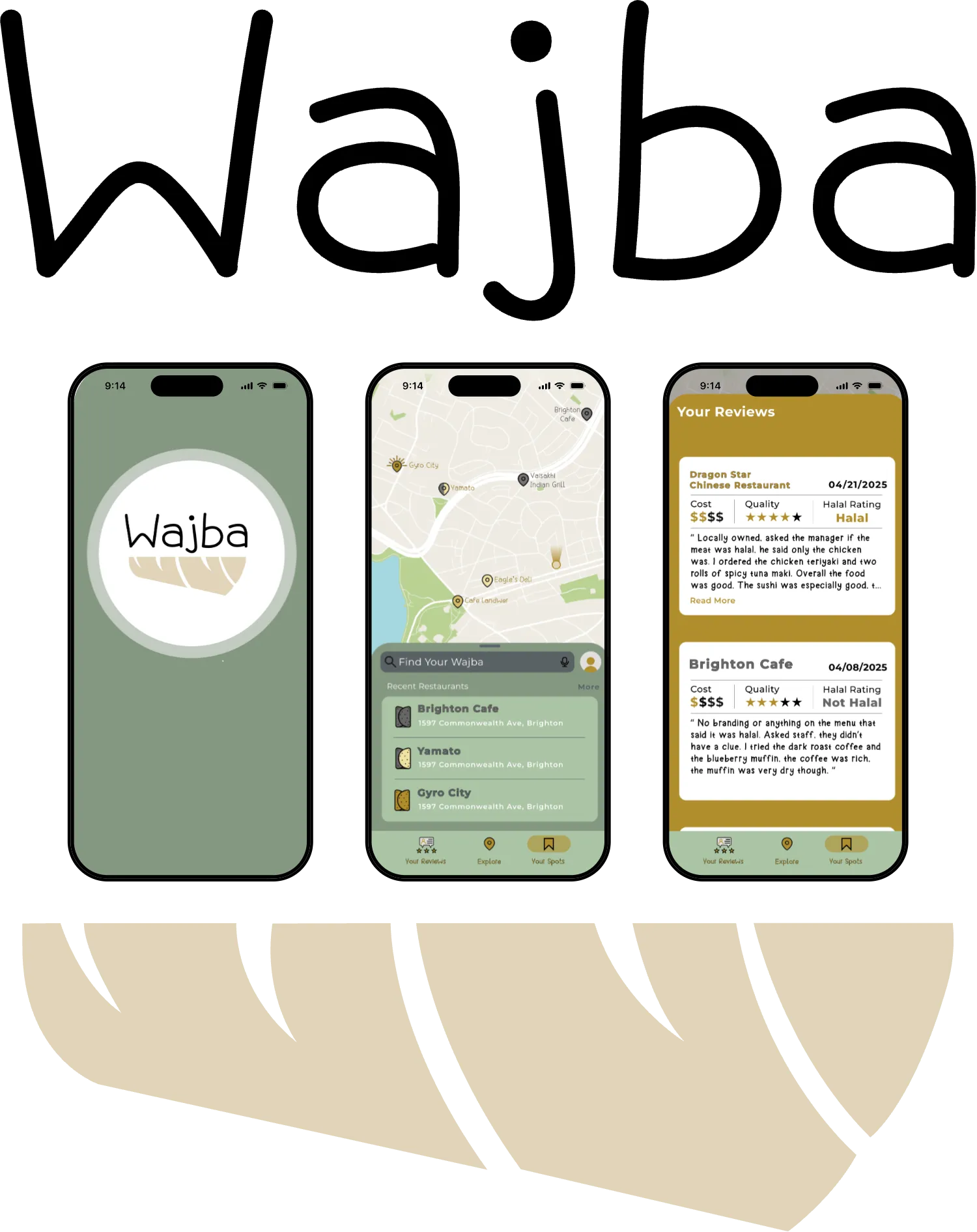
Wajba is a solution
that streamlines
eating out halal
Eating out as a halal eater can be challenging. Options can be limited and verifying if a restaurant is credibly halal or not can make eating a out a chore, if not entirely off the table in certain areas. Wajba aims to fix that. With its halal-rating system, users can review their local restaurants as halal or not halal, leaving their mark so any future passerby can be aware of what halal food options are present in a given area.
Research
User Research:
User research was the first avenue of research I utilized as it is the easiest way to understand what problems halal eaters face when trying to eat out. I opted for both a user survey and user interviews for a mix of quantitive data and qualitative.
User Survey:
- -10 Questions: 7 Multiple choice, 1 multiple answer, 2 long answer
- -14 Responses
- -5-10 minutes to complete
- -Participants consisted of college students in Boston area
Results & Takeaways:
(A select few charts from the survey results, full results linked below)
-Eating out is a regular behavior for most respondents, making halal food discovery a recurring need rather than an occasional inconvenience.
-Many respondents reported having only a limited number of halal options near home and school, pointing to a real access and availability gap.
-Variety matters to every respondent, showing that users are not just looking for halal food—but looking for choice within it.
-Trust is a central part of halal food discovery, with most users relying on word of mouth, branding cues, or direct confirmation from staff.
-Users often depend on informal verification methods, suggesting that existing tools do not provide enough confidence on their own.
-The biggest frustrations are not just limited options, but ambiguity around whether a place or specific menu item is actually halal.
-There’s a need for a tool that combines discovery, verification, and user-submitted clarity in one place.
Survey Results Link (opens in a new tab)User Interviews:
- -10-15 minutes in duration
- -3 interviews
- -Questions structured using funnel technique
- -Participants consisted of college students in Boston area.
Name tags and or faces blurred per request of each participant.
Results & Takeaways:
-Moving to college consistently made halal eating harder, forcing students to navigate fewer options, weaker variety, and less certainty.
-Users trusted people more than platforms: friends, social media, and direct conversations with staff were more useful than Google Maps or Yelp.
-The challenge was not simply finding food nearby, but knowing with confidence whether that food was actually halal.
-When information on a restaurant was unclear, users either settled for the same known spots or compromised on their ideal eating habits.
Comparative Analysis:
Seeing how popular tools for finding halal succeed and fail was a necessary step in understanding what gaps there were in users’ experiences and how to fill them.
I decided to focus in on Yelp and Google Maps as both were the most frequently cited tools in both the user survey and the user interviews.

Pros
- User reviews are more in depth.
- UI is easy to navigate
Cons
- Hard to find non-branded halal spots.
- Hard to find reviews confirming if halal.
- Most halal results are middle eastern.
Pros
- Can find many nearby spots.
- Provides directions and restaurants details.
Cons
- Search omits non-branded halal spots.
- Restaurant details can sometimes be wrong.
- Most halal results are middle eastern.
User Survey + User Interview + Comparative Analysis
Challenge Statement:
Muslim halal eaters need a better way to find nearby halal food, confidently verify its credibility, and explore a wider range of reliable options, since current discovery methods often lack visibility, trust, and variety.
Ideation
The Halal Scoring System:
The research phase had shown me two things: where halal eaters struggled when using digital food recommendation services and where those services succeeded and fell short. My goal then became to come up with a solution that addressed their pain points and fill the gap the current services left.
My solution had to:
- -Make finding halal food easy.
- -Validate if a restaurant was halal in a way halal eaters trusted.
- -Easily and credibly identify halal restaurants that weren’t overtly halal.
- -Give halal eaters a variety of options.
- -Not sacrifice quality of results and allow for restaurant ratings to be part of the filtering process.
- -Easily distinguish between halal and non-halal restaurants.
- -Distinguish between fully halal restaurants and restaurants with some halal menu items.
My solution?
Wajba is a food locating/recommendation app that combines the best features of the top apps in it’s niche while filling the gaps said apps leave for halal eaters.
Using Google Maps’ API, all nearby restaurants pop up on a user’s map as pins, starting off greyed out to indicate they’re unreviewed. A user can engage with the restaurant with either a halal-highlight to indicate it’s halal or a flag to indicate it isn’t. Both halal-highlights and flags take the user to their respective forms where they can detail how they found out about the restaurant’s halal-status, their rating of the restaurant, and write a review.
Wajba allows users to work together to make eating out halal an easier, and more enjoyable time, but users can only do so much without a good system to make use of their efforts. Halal eaters don’t operate within a binary of halal or not halal, they often have to make their best judgement on limited information. Some eaters are more willing to eat at a restaurant of word of mouth, some need a halal certification to feel comfortable. Some restaurants are fully halal, some just have some halal menu items. It was clear to me that taking this into account was what would separate Wajba from the unwieldy apps and services already available.
The Halal
Scoring System:
The halal scoring system is at the core of Wajba and depends on users to work!
How halal scores are calculated is simple; The reviews left on a restaurant or market are averaged out and a percent of the reviews that are halal highlights are the score displayed.
The Grey map pin represents all restaurants and markets that are either unreviewed or have a halal score below 51%. All pins start out grey, but can change as reviews come in.
The light gold map pin represents all restaurants and markets that have halal scores ranging between 51%-74%. Restaurants with this pin have a majority consensus from reviewers that they’re halal, but not one so overwhelming that your due diligence isn’t still reccomended.
The dark gold map pin represents all restaurants and markets that have halal scores ranging between 75%-100%. Restaurants with this pin have an overwhelming majority consensus from reviewers that they’re halal, letting even the most cautious of halal eaters dine with having to bat an eye.
The half & half map pin is meant to encompass a greater variety of restaurants by accounting for places that aren’t fully halal, but at least have a few options for halal eaters.
To have received the half & half map pin, a restaurant or market will have a majority of their reviews be Halal Highlights, but will also have over 50% of their Halal Highlights have option B of question 1 (“Has some halal menu items. ”) be chosen in the accompanying Halal Highlight survey.
Grey pin — Unreviewed or below 51%Light gold pin — 51%–74% halal scoreDark gold pin — 75%–100% halal scoreHalf & half pin — Majority halal, some halal menu items
Branding
Logo:
Derived from the arabic word for meal
Inspired by the dish, shawarma, a hall mark of Arab cuisine.
Colors:
The colors were inspired by those symbolic of and pervasive in Islam (green & gold) and colors that evoke the feeling of the kinds of food’s much of Wajba’s user base grew up on (hummus, shawarma, falafel, etc).
Typography:
Belal
- Informal in its feel and reminiscent to the locally owned eateries and shawarma stands in Jordan my family and I would go to when we’d visit.
- Uncommonly used, making it unique and recognizable as a logo font.
Montserrat
- Highly legible as a clean san-serif and versatile with its numerous font weights, perfect as the app’s primary font

- Used solely for the user review text. More legible as a body copy font than Belal, but still has it’s handwritten, informal feel.